OTA vs Direct Bookings for Hostels: The Real Math
OTAs aren't the enemy and direct isn't a silver bullet. Here's what each actually costs you, and how to build a channel mix that protects both your beds and your margin.
Published: 27 June 2026 - 10-minute read
Let's fix the framing first, because most advice gets it wrong: this isn't a war you win by 'killing the OTAs.' OTAs are paid marketing, you rent their audience and pay a commission when it converts. Direct bookings are your margin, your guest data, and your relationship. A healthy hostel uses both on purpose: OTAs to get discovered, direct to stay profitable. The goal was never zero OTA. It's the right mix, with the cheap channel growing faster than the expensive one.
So the real question isn't 'OTA or direct?' It's 'what is each booking actually costing me, and how do I move more of my demand onto the channel I own?' Let's do the math, then the playbook.
What an OTA booking really costs you
An OTA booking looks free until you read the invoice. Commission on the big hostel channels typically runs 12% to 18% of the booking value, and it climbs the moment you opt into 'preferred' or visibility-boost programs, sometimes 20-25%. On a €20 bed, 15% is €3 a night gone before you've washed a single sheet.
Now stack it up. A 60-bed property pushing 70% of its nights through OTAs at 15% is handing over real money every month, often more than a staff salary. None of that is wasted, the OTA earned those bookings, but you should at least know the number. Run your own rates and mix through our OTA commission calculator and look at the annual figure. It has a way of focusing the mind.
- Commission is the obvious cost: usually 12-18%, more with paid placement.
- The hidden costs add up too, virtual card fees, currency conversion, and the guest data you never get to keep, and catching the first two is exactly what payout reconciliation is for.
- The opportunity cost: an OTA guest is the OTA's customer, not yours. They'll market to that guest forever; you may never see them again.

What OTAs are genuinely good at (don't skip this)
Here's the part the 'go direct or die' crowd glosses over: OTAs are genuinely good at things you can't easily replicate, and pretending otherwise costs you beds.
- Discovery. A traveler in Hanoi searching for a bed in Lisbon finds you on Hostelworld long before they find your website. That reach is real, and for a new or unknown property it's close to irreplaceable.
- The billboard effect. A chunk of guests find you on an OTA and then book direct anyway. The listing advertises you for free even when it doesn't get the booking, which is exactly why pulling off OTAs entirely tends to backfire.
- Filling the awkward nights. OTAs are brilliant at moving last-minute, low-season, and odd-date inventory you'd struggle to sell on your own.
What direct bookings win on
Direct bookings win on everything that compounds. The first booking might cost about the same once you count your own marketing, but every booking after that is where direct pulls ahead, hard.
- Margin. A direct booking through your own direct booking engine costs you payment processing (~2-3%), not 15-20%. That gap is pure profit on every single night.
- The guest is yours. You get their email, their preferences, and permission to talk to them. That's the foundation of repeat stays and referrals.
- Control. Your cancellation terms, your upsells, your check-in flow, your brand, not an OTA's template.
- Relationship. A guest who booked with you directly is a guest you can turn into a regular, and backpackers travel for years.
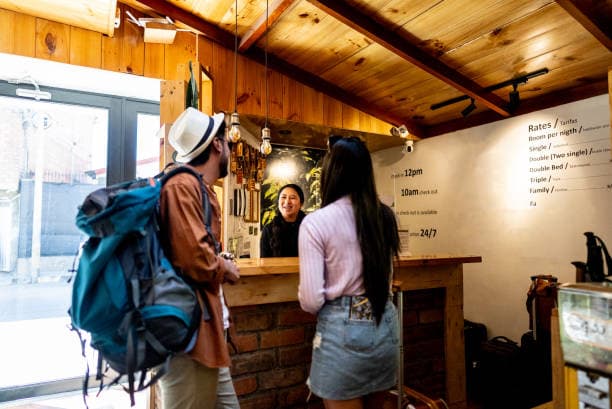
The one number to watch: your direct booking ratio
Forget vanity metrics. The number that tells you whether you're winning is your direct booking ratio, the share of your bed-nights that come through channels you own: your website, walk-ins, phone, repeat guests. Most hostels sit somewhere between 15% and 35% direct. There's no magic target; the direction matters more than the absolute. Is that share growing year over year?
- Measure direct as a share of bed-nights and of revenue, not just bookings, OTA guests and direct guests don't always stay the same length.
- Watch the trend, quarter over quarter. A direct ratio creeping from 20% to 30% over a year is a genuine margin win.
- Compare RevPAB by channel. If your direct RevPAB beats your OTA RevPAB (it usually does, no commission), that's the financial case for the whole effort in one line.
How to grow direct without losing your OTA rankings
This is the part that actually moves money. You grow direct not by punishing OTAs, but by giving guests a reason to skip the middleman while keeping your OTA listings healthy. The trick: never break rate parity in a way that gets you penalized, and win on value instead of a lower number.
- Keep rate parity, win on perks. Match the OTA price, then make direct obviously better, free towel, late checkout, a welcome drink, skip-the-line check-in. Same price, better deal.
- Make booking direct effortless. A fast, mobile-first direct booking engine with live bed availability is non-negotiable. If your site is clunkier than the OTA, guests won't bother.
- Win the guest at the desk. The best moment to earn a repeat direct booking is while they're standing in your lobby, loving the place. A little card, 'book us direct next time, here's 10% off', beats any ad.
- Automate the follow-up. A friendly pre-arrival and post-stay message nudges direct rebooking and reviews without feeling like spam.
- Use the billboard effect on purpose. Make your name memorable and your website easy to find, so the guest who discovered you on an OTA comes straight to you next time.
Mistakes that cost you both channels
The failures here are rarely dramatic, they're the quiet, confident ones that feel smart at the time:
- Going direct-only too early. Pulling off OTAs before you have your own demand is how new hostels end up with empty beds and a lovely website nobody visits.
- Undercutting your OTA price on your own site. It feels clever; it gets you flagged for parity violations and can bury your OTA ranking. Win on value, not a lower headline number.
- Ignoring the hidden costs. Commission is just the headline. Virtual card fees and lost guest data are real line items too.
- Treating every OTA the same. Hostelworld, Booking.com, Agoda, and Airbnb pull different guests at different commissions. Know which one earns its cut and which one doesn't; what Hostelworld actually charges is a good place to start.
- No plan to capture the relationship. Take an OTA booking, never try to turn that guest into a direct one, and you've paid for a customer just to give them away.
A 90-day plan to grow direct
If you want the concrete version, here it is, four moves over a quarter:
- 01
Weeks 1-2, measure.
Pull your real channel mix and total commission. Work out your direct ratio and your RevPAB by channel. You can't improve what you haven't counted.
- 02
Weeks 3-4, fix the basics.
Make your direct booking engine fast and mobile-first, match your direct rate to OTA parity, and add one clear direct-only perk.
- 03
Weeks 5-8, win at the desk.
Train the team on a simple 'book direct next time' ask, with a small incentive on a card guests take home.
- 04
Weeks 9-12, automate.
Switch on pre-arrival and post-stay messages that invite direct rebooking, and email past guests before your low season.
- 05
Then repeat.
Re-check the direct ratio every quarter. Keep OTAs healthy for discovery; let direct quietly take the repeat business.
When OTA commission is the best money you'll spend
To be fair to the other side: there are moments when fighting OTA commission is the actual mistake.
- You're brand new and nobody is searching for you yet. OTAs buy you instant visibility while you build your own demand.
- You're entering a new market where your brand means nothing. Let the OTA's reach handle the introductions.
- It's low season and you have beds you'd otherwise sleep at zero. A commissioned booking beats an empty bed, every single time.
- It's a last-minute, odd-date gap that OTAs are simply far better at filling than you are.
Ready to Manageyour dream Hostel?

OTA vs direct bookings: FAQs
Both, on purpose. OTAs are paid marketing that gets you discovered; direct bookings are your margin and your guest relationship. The smart move isn't to pick one, it's to use OTAs for reach while steadily growing the cheaper direct channel, especially for repeat guests.
Usually 12% to 18% of the booking value on the major hostel channels, and higher, often 20-25%, if you opt into preferred placement or visibility programs. On a €20 bed at 15%, that's €3 a night gone before any costs. Run your real numbers through an OTA commission calculator to see the annual total; it's usually bigger than owners expect.
Most hostels sit between 15% and 35% direct. There's no universal target, the trend matters more than the number. A direct ratio growing year over year, with your direct RevPAB beating your OTA RevPAB, means the effort is paying off.
Keep strict rate parity, never undercut your OTA price on your own site, and win on value instead: free perks for direct guests, a fast mobile booking engine, and a simple 'book us direct next time' ask at the desk. You grow direct by being the better deal at the same price, not the cheaper one.
Almost never, and rarely all at once. OTAs drive discovery and the billboard effect, many guests find you on an OTA and book direct anyway. Pulling off completely usually costs more in lost reach than you save in commission. Shrink your OTA dependency gradually as your direct demand grows.
No, and you shouldn't. Match the OTA price on your own site and make direct better with perks and experience, not a lower headline number. Undercutting parity can get your listings penalized or buried, which costs you the discovery you were paying the OTA for in the first place.
Want to see what OTA commission is really costing you? Run your numbers through our OTA commission calculator, then see how HostelMate's commission-free direct booking engine keeps more of every booking, and check our pricing when you're ready to make the switch.